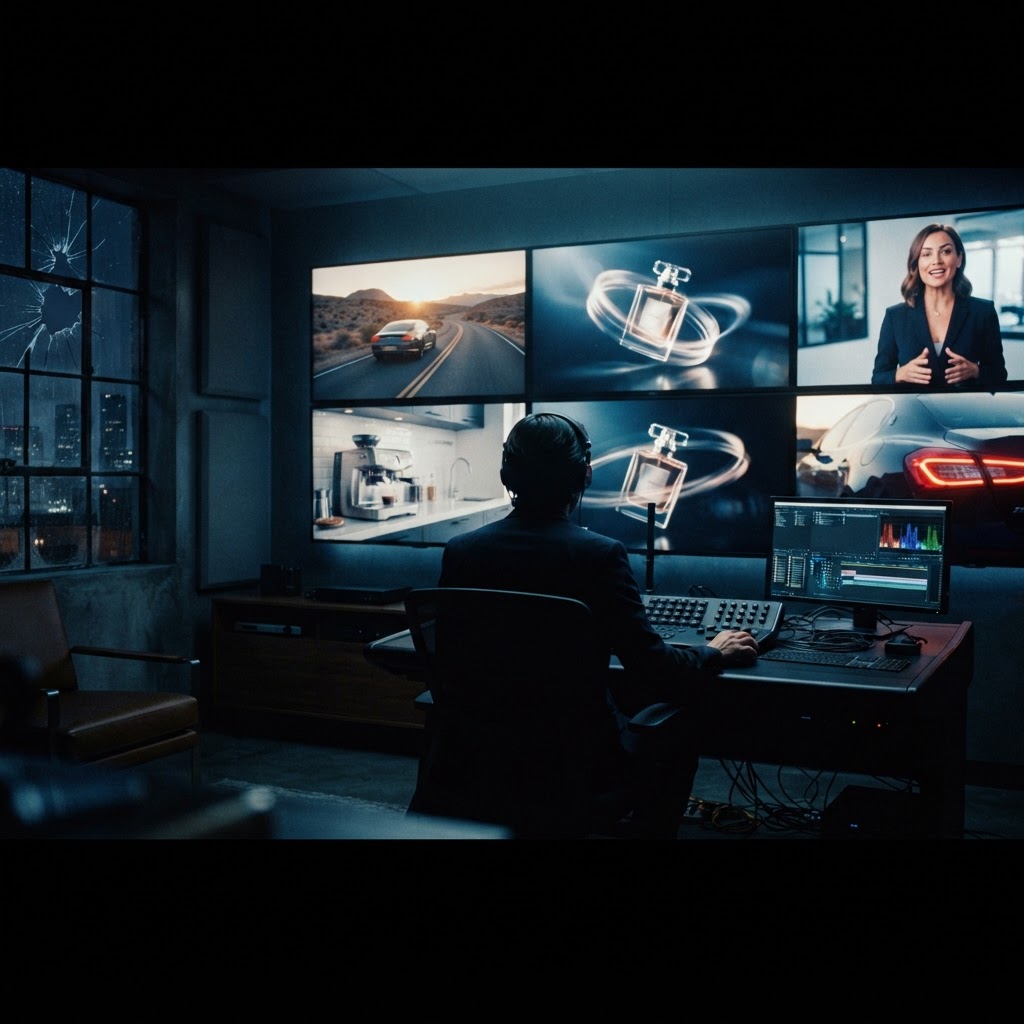
For most of the last fifty years the thirty second ad was a small film. It had a director, a casting session, a location, a wardrobe rail, a food stylist and a lawyer who read the script twice. It took six weeks and it was, in the way that mattered to everybody involved, expensive. Expense was not a byproduct of the process. It was the process. It was the reason the idea had to be argued for before anyone was allowed to shoot it.
That is now optional. Through 2024 and 2025 the tools moved out of the demo reel and into the places where media actually gets bought. Veo 3 arrived inside Google Ads with audio and eight second clips. Meta put generative creative in the same window where its advertisers already build campaigns. Sora 2 made photoreal ten second video a consumer product and then had to invent rights rules in public, because the first thing everyone did was point it at somebody else's work.
The numbers underneath went boring, which is how you know a technology has won. Meta has said more than a million advertisers have used its generative creative tools, with tens of millions of ads produced, and its automated campaign layer is running at a scale that would place it among the largest media owners on earth on its own. Nobody ran a campaign about that. It simply became the default, quietly, for the advertisers least likely to be invited onto a panel about it.
Which brings us to the actual scarcity. The world has never lacked advertising minutes, and it does not lack them now. It lacks attention, and attention is the one input that did not get a model upgrade this year. If the cost of a competent frame falls towards zero while the supply of attention stays fixed, the industry's problem stops being production and becomes entirely a question of who is worth watching. That is not a technology question. It is a strategy question, and it is being answered badly in most boardrooms.
So we asked the only question with an interesting answer left in it. Not what can it do. What does it do to us. Same wording to LinkedIn and to the OTTRED community, one vote each on LinkedIn, five options including Other in the community, followed by a second community poll with multiple selections allowed, because forcing a single answer on a subject like this hides the thing we most wanted to see.